Nextdoor: Neighborhood Network
- 4.5
- Rating
- 10.00M
- Installs
- Free
- Price
 Analysis by App-foxy
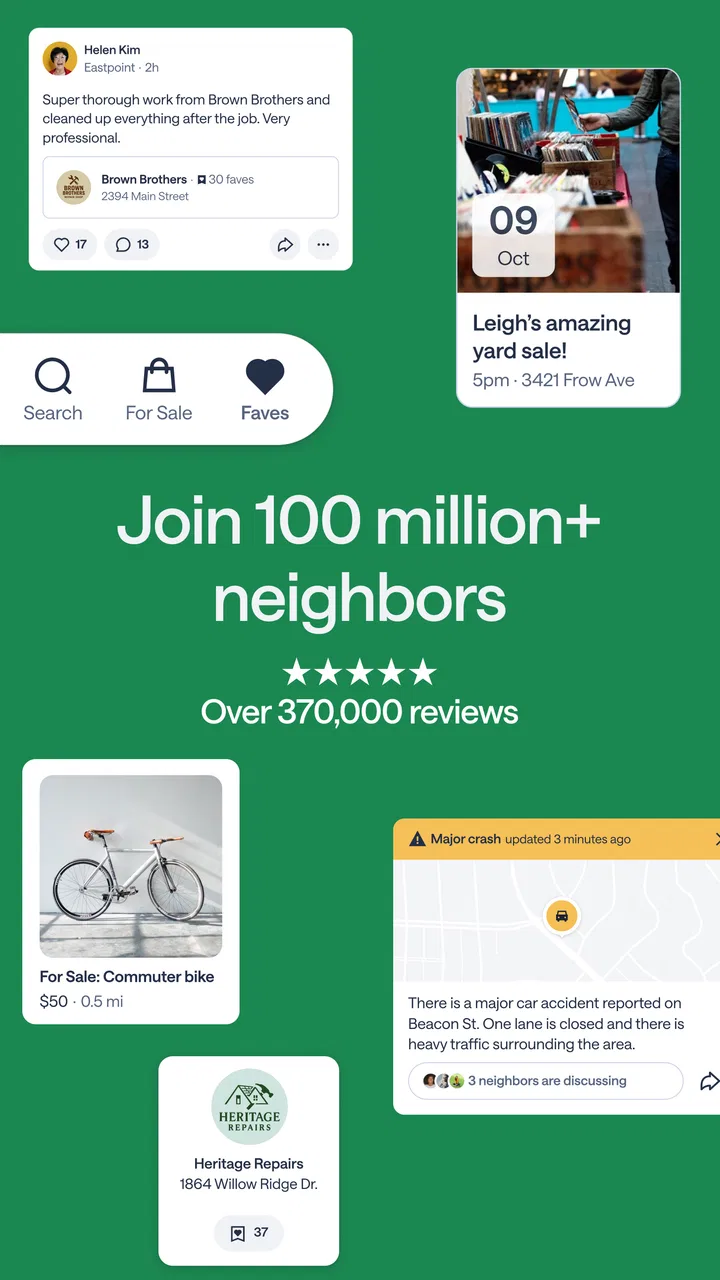
When I first opened Nextdoor, I understood its appeal almost immediately: it is built around the places and people near me rather than around distant contacts or broad public audiences. The app brings neighborhood alerts, local news, recommendations, marketplace posts, events, and everyday questions into one stream. That makes it feel less like a general social network and more like a digital noticeboard that travels with you.
Nextdoor, Inc. develops this free lifestyle app, which is available for teenagers and older users. It has reached over 10 million installs and holds a 4.6 average from around 407 thousand ratings, so it is clearly familiar to a large audience. I found that popularity useful in some situations, because a neighborhood network only becomes valuable when enough nearby people actually participate. At the same time, the quality of the experience depends heavily on how active and considerate the local community is.
My overall impression is positive, but with an important qualification: this is an app whose usefulness rises and falls with connectivity and local participation. When the connection is good and people nearby are posting practical information, it can be surprisingly helpful. When the feed is quiet, repetitive, or filled with arguments, it becomes much less compelling than a simple group chat, a local website, or a conventional marketplace.
You May Also Like

 Blood Strike: 2.5 Anniversary
Blood Strike’s Loadouts Turn Every Drop Into a Tactical Gamble
A close look at Blood Strike’s custom loadouts: how fast access to signature weapons reshapes its battle royale rhythm, rewards preparation, and narrows the gap between fights.

 Pandora - Music & Podcasts
Pandora’s Music Is Easy to Start, but Harder to Recover
Pandora’s strength is its low-effort path from a seed to a station. Its weak spot is how much confidence it asks you to place in connection, setup, and quiet recovery.

 8 Ball Pool
 Is Built on Rivalries, Rematches, and Routine
A close look at the rivalries, rematches, shared routines, and unanswered safety questions that turn a quick pool match into a persistent mobile community.

 Samsung Music
’s Quiet Strength Is Playing What You Already Own
Its reach comes less from spectacle than from dependable access to a personal library. That simplicity is both the app’s strongest retention engine and its ceiling.

 AccuWeather: Weather Radar
AccuWeather Review: A Quick, Clear Forecast for Everyday Decisions
For everyday plans, the best forecast is the one you can understand quickly. AccuWeather makes rain timing, radar, and local conditions easy to act on, with a few trade-offs.

 Hill Climb Racing
Why Hill Climb Racing Still Turns Crashes Into One More Run
A tiny car, a bumpy hill and one more upgrade: Hill Climb Racing keeps resurfacing because its simple chaos makes every near-miss feel personal.
More From Our News Desk
View All News


How Nextdoor works when the neighborhood is connected
I find Nextdoor most useful when I begin with a specific local question rather than opening it just to scroll. I check whether nearby conversations are active, then use that signal to decide whether to ask, browse recommendations, or look for a relevant event. That small choice helps me treat the neighborhood feed as a practical starting point, while keeping a more direct source in mind when timing or certainty matters.
A local feed with a different kind of purpose
The main strength is the way the app narrows attention to a local area. Instead of asking me to follow celebrities, brands, or distant acquaintances, it encourages me to look at what is happening around my home. That changes the value of an ordinary post. A question about a lost item, a recommendation for a repair service, or a warning about a road problem can matter because it is geographically relevant.
I especially like the difference between browsing for entertainment and checking for practical context. The feed is not always exciting, but it can answer questions that are difficult to solve through a normal web search. A search engine may show highly ranked businesses across an entire city, while a neighborhood discussion can reveal which service is familiar to people living close by. That local perspective is the reason I would install it, not simply the presence of another social feed.
The app also combines several types of local activity that are often scattered across different places. News and alerts sit alongside recommendations, events, and a marketplace. This makes discovery convenient, although it also means the feed can feel mixed and unpredictable. A useful safety update may appear between casual discussions, sales posts, and opinions that do not deserve much attention.
Why a live connection matters so much
Nextdoor is most effective when I am actively connected and able to refresh the local stream. Its core experience depends on receiving current posts and sending my own questions or replies. That matters during a neighborhood event or a developing local situation, when information can change quickly. A stale view is less useful than a current one because local information loses value as circumstances change.
A realistic example is arriving home and finding that access to a nearby street is difficult. I can check the app to see whether neighbors are discussing an obstruction, an event, or another local issue. If the network is available, the app may help me understand the situation faster than waiting for a formal announcement. I would still treat individual posts as community reports rather than official confirmation, but the speed of local conversation can be valuable.
The same pattern works for a missing pet or an item left in a public place. A post can reach people who are physically close enough to notice something that a broad social platform would bury. The benefit is not a sophisticated tool; it is the combination of location, timing, and a network of nearby users.
What happens on the move
I think the app makes the most sense in short, purposeful mobile sessions. I might open it while walking through the neighborhood, before attending a local event, or when I need a recommendation from people nearby. The interface is suited to checking a stream, reading a few replies, and deciding whether a post deserves action. It is less appealing as something I would keep open continuously throughout the day.
Mobile use also changes how carefully I read. When I am standing in a queue or moving between errands, it is easy to react to a headline without understanding the full discussion. That is risky on a community network, where a partial account can sound more certain than it really is. My habit is to read the original post, check the replies, and look for specific details before passing information along.
For event discovery, the mobile format is convenient because I can check local activity while already making plans. I can see whether something nearby sounds relevant without opening several unrelated services. However, I would not rely on a short feed preview for important arrangements. I still confirm the time, place, and any changes through the event information itself or with the organizer.
Connection problems and sensible recovery
When connectivity is weak, the app becomes frustrating for a simple reason: the parts I care about most are current conversations. A delayed feed can make a post appear less timely, while a failed submission can leave me unsure whether a question or reply went through. I avoid repeatedly tapping buttons in that situation, because duplicate posts or replies create unnecessary clutter if the first attempt eventually succeeds.
My preferred recovery routine is straightforward. I pause, check whether the connection has returned, and then look for the post or message before trying again. If I was composing something detailed, I keep a copy of the wording until I know it has been published. This is particularly useful for a marketplace listing or a community question that would be annoying to recreate.
Connectivity also affects how I use the app for time-sensitive information. If I am already dealing with an urgent situation, I would not make Nextdoor my only source of help. It is a channel for local awareness and conversation, not a replacement for emergency services, official notices, or direct contact with someone who can respond immediately.
Using the marketplace without losing perspective
The marketplace is one of the more practical parts of the service, especially when I want to look for nearby listings rather than browse a huge national catalog. Local distance can make exchanges simpler, and neighborhood context may give a listing more relevance. I can also imagine it being useful for finding an item that would be inconvenient to ship or for noticing offers from people in the surrounding area.
There is a trade-off, though. A local audience does not automatically make a transaction safe or reliable. I would inspect the listing carefully, clarify the condition and arrangement, and avoid treating a familiar-looking neighborhood profile as proof of trustworthiness. The app can help people discover one another, but the responsibility for a sensible exchange remains with the participants.
I also found that local marketplaces work best when I search with a clear purpose. Casual scrolling can become noisy, especially when listings are mixed with other neighborhood content. If I know what I need and check posts consistently, the feature feels useful. If I expect it to replace a dedicated buying-and-selling service with a larger inventory, I may be disappointed.
Recommendations are helpful, but not absolute
Recommendations are another area where the local network can outperform generic search in a narrow way. People nearby may know which cleaner, tutor, gardener, or repair professional has worked in homes like theirs. The comments can reveal practical details that a business profile does not show, such as communication habits or whether a service suits a particular kind of job.
Still, I would compare several opinions instead of accepting the most enthusiastic reply. A recommendation reflects one person’s needs, budget, and expectations. A service that worked well for a small task may not be suitable for a larger one. I also pay attention to whether a reply contains concrete experience or merely repeats a general compliment.
This is where Nextdoor differs from a review platform. Its conversations are more immediate and local, but they may be less structured. A dedicated review service is usually better when I want to compare many providers systematically. Nextdoor is better when I want a quick, human suggestion from people who live close enough to understand the local context.
Keeping the feed useful instead of overwhelming
The app’s broad mix of topics is both its attraction and its weakness. Local alerts, event information, marketplace activity, and casual conversation can all be relevant at different times, but not necessarily at the same time. I get more value when I treat the feed as something to curate rather than something I must read from top to bottom.
I also think carefully before joining a discussion. A neighborhood thread can become more heated than the original issue deserves, and a public reply may remain visible to a much wider local audience than I initially imagine. I prefer short, specific contributions: a clear answer, a useful question, or a correction with a reliable reason. That approach makes the network more practical and reduces the chance of adding noise.
Privacy is another reason to be deliberate. Local posts can reveal routines, nearby landmarks, or details about a household even when the writer does not intend to share much. I avoid publishing information that would make my absence, schedule, or exact location obvious. The convenience of a neighborhood network should not encourage me to overshare simply because the audience feels familiar.
Who will appreciate it most
I would recommend Nextdoor to people who want a local pulse rather than another broad social timeline. It is especially suitable for someone new to an area, a person looking for nearby recommendations, or a household that wants to notice local events and community conversations. It can also help people who prefer asking a group of nearby residents instead of searching through anonymous results.
It is less suitable for someone who dislikes community discussion, wants strictly verified information, or expects a consistently quiet and focused interface. If I only need to communicate with a small set of trusted neighbors, a private group chat may be more comfortable. If I want a large selection of products, a dedicated marketplace may offer better search and variety. If I need formal local news, an established news source or municipal channel is the stronger choice.
The app is also not a substitute for direct relationships. Reading local posts can create a sense of awareness, but it does not necessarily build trust as effectively as speaking to neighbors in person or maintaining a small private group. I see Nextdoor as a discovery and information layer, not as the complete foundation of community life.
Device requirements and everyday expectations
The current version is 5.1.4 and requires Android 8.0 or later. That makes it accessible on many older Android devices, although the real experience will still depend on the phone’s performance, available storage, and connection quality. Because the app is free, trying it carries little financial risk, but the more important question is whether enough people in my area use it actively.
The Teen content rating is worth keeping in mind for households deciding how younger users should interact with neighborhood discussions and marketplace posts. A local feed can contain mature disagreements or information that needs adult judgment, even when the app’s purpose is ordinary community communication. I would discuss sensible posting and privacy habits with a teenager rather than assuming the rating removes the need for supervision.
Its scale is impressive: the app has accumulated around 89 thousand written reviews in addition to its larger pool of ratings. I take that as evidence of sustained attention, not as a guarantee that every neighborhood will feel equally lively. A widely installed app can still be quiet in one particular area, and local participation is the factor that determines whether the service becomes part of my routine.
My connectivity verdict
After using Nextdoor as a local information stream, I see its best quality clearly: it connects ordinary questions to people who are close enough to provide relevant answers. That can make a difference when I need a nearby recommendation, want to notice an event, or am trying to understand something happening around the neighborhood. The value comes from immediacy and proximity, not from replacing every other app I use.
The main limitation is equally clear. A network built around current community activity is only as useful as its connection, participation, and conversation quality. Weak connectivity can interrupt the experience, while an inactive or argumentative local feed can make the app feel like extra noise. I also need to use judgment with alerts, recommendations, and marketplace exchanges instead of treating every post as verified fact.
My final recommendation is conditional but genuine: try it if you want a broad local window and are willing to curate what you read. Start by checking whether nearby posts are recent and practical, then decide how often the app deserves your attention. Nextdoor works best as a connected neighborhood tool, not as an all-purpose social replacement. For me, that focused role is enough to make it worthwhile, especially when I need local context that a general search engine or private chat cannot provide.
FAQs for Nextdoor: Neighborhood Network
01What is Nextdoor and how does it work?
Nextdoor is a private social network designed specifically for your neighborhood. It allows you to connect with nearby residents to share information, recommendations, and updates about local events. Users can post about anything from lost pets to safety concerns, making it a valuable tool for fostering community engagement and awareness.
02Is my information secure on Nextdoor?
Nextdoor prioritizes user privacy by requiring address verification, ensuring that only real neighbors can join your neighborhood network. The platform implements robust security measures to protect your data, and users can control their privacy settings to decide who sees their posts and information. Always review privacy options to tailor your experience.
03How do I join my neighborhood on Nextdoor?
To join, download the Nextdoor app and sign up using your address. The app will verify your residency by sending a postcard with a unique code or through other verification methods like phone billing. Once verified, you can access your neighborhood's group and start participating in local discussions and activities.
04What features does Nextdoor offer?
Nextdoor offers a range of features, including local news updates, event postings, and a marketplace for buying and selling items. You can also use it to find recommendations for services, report safety issues, or simply get to know your neighbors. The app is designed to enhance local communication and resource sharing.
05Can I use Nextdoor for business promotion?
Yes, businesses can create a Nextdoor Business Page to engage with local communities. This feature allows businesses to post updates, share promotions, and respond to customer inquiries. However, it's important to follow community guidelines and ensure that promotions are relevant and respectful of neighborhood interests.
Pros
- Connects you with local community easily.
- Find neighborhood services and events quickly.
- User-friendly interface for all ages.
- Receive real-time local alerts and updates.
- Facilitates buying and selling locally.
Cons
- Privacy concerns with personal data sharing.
- Can receive too many notifications.
- Limited to neighborhood-specific interactions.
- Some users report occasional app crashes.
- Requires location data for full functionality.

Nextdoor: Neighborhood Network
Gallery